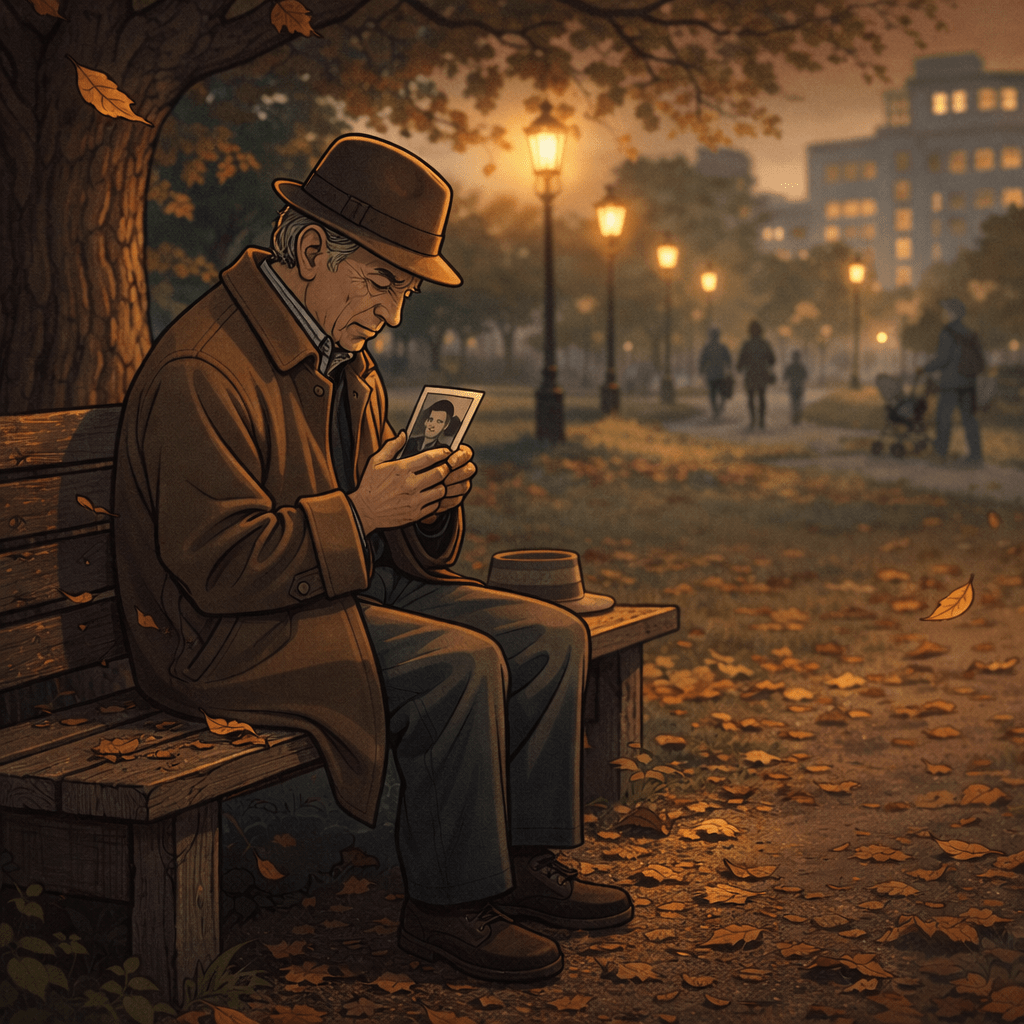
The bench had once been a tree.
It did not remember the forest clearly anymore — only light filtered through leaves, the deep patience of roots pressing into dark soil, the particular silence of something that has stood long enough to stop counting years. The rest had become distance. Saw. Sanding. Nails. Varnish. A reshaping that kept the grain but changed everything else.
Now it stood beneath an oak in a small park, iron arms curled into quiet spirals, its wooden slats worn silver where countless hands had rested, darker where rain gathered and stayed. A faint crack ran along the third plank — not enough to split, only enough to remind that even the things built to last carry their history in them.
Most days it held sunlight and strangers.
Some days it held something else entirely.
He first appeared on a Tuesday in late October.
The hospital was visible from the bench — just beyond the park’s far edge, its upper floors catching the last of the evening light. At exactly half past four the doors released their daily tide — nurses changing shifts, visitors carrying flowers they hadn’t given, families walking toward the car park with the careful faces of people managing what cannot be managed.
He walked out alone.
Coat the colour of old tea. Hat slightly too large, as if bought in a different decade when he had been a bigger man. He moved slowly — not frailty exactly, but the deliberate pace of someone who had stopped seeing the point of hurrying. The evening air pressed against him and he did not adjust his collar or quicken his step.
He found the bench the way people find things they were already looking for without knowing it.
He sat.
His hands rested open on his thighs, palms down, fingers slightly curled — the hands of a man who had held many things and set most of them down and was learning, now, what it meant to have almost nothing left to hold. He did not look at a phone. Did not read. Did not watch the joggers or the dog walkers moving through the lamp-lit paths around him.
He looked at the middle distance.
At nothing. At everything. Without preference.
The park settled into its evening quiet around him. The oak above released a single leaf, which turned slowly on its way down and came to rest against his shoe. He did not move it.
On the third evening he reached into his coat and removed a small envelope, worn soft at the edges from handling. He held it in both hands without opening it — the way you hold something you are not yet ready to look at but cannot bring yourself to put away.
On the fifth evening he opened it.
Inside was a photograph.
He placed it on the bench between his hands with the care of someone setting something irreplaceable on uncertain ground. The evening wind lifted and he placed two fingers gently on its edge.
A young man in the photograph. Smiling the way young men smile when they have not yet learned that some smiles will be the last ones. Behind him, somewhere dry and far away, a sky the colour of bleached bone.
The old man looked at it for a long time.
Then, quietly — so quietly that the park absorbed the words before they reached anywhere — he began to talk.
Not to himself.
To his son.
He had carried the loss the way men of his kind carried things — upright, forward, without putting it down. Not because he was strong. Because he had never been shown where the ground was. Nobody had ever said — here, you can set it here, just for a moment, it will still be yours when you pick it back up.
So he had kept walking. Decades of walking. Through the funeral with its terrible brightness. Through the years that followed, each one asking him to continue as if continuation were a simple thing.
Through the mornings when he woke and for one half-second did not remember. And then did. And the weight resettled across his chest like something that had never truly left.
He had not wept at the grave.
He had not wept anywhere that anyone could see.
Grief, for a man like him, had no door. It had no room of its own, no hour set aside, no language he had been given to speak it aloud. It lived instead in the tension across his shoulders that his wife used to press her palm against without a word — just her hand, warm and steady, knowing without asking what she was holding. In the way he still set two cups out sometimes in the morning before remembering. In the way his son’s name, spoken by someone who did not know its weight, could stop him mid-step on an ordinary street and cost him something he could not name or recover before the next breath.
His son had been deployed overseas.
A foreign country. A cause the old man had never been certain of — had turned over in his mind for twenty years like a stone he kept hoping to find something underneath and never did. He had never said this aloud. Not even to his wife. What would it have given back. What would it have changed. So he had folded the doubt and placed it beneath everything else and continued.
His wife had carried it with him.
Not in words — they had not been a family of words — but in the way she knew when to sit close and when to leave him alone. In the way she said their son’s name sometimes, quietly, over breakfast, as if keeping him present in the room so he would not have to be kept present alone. In the way she had kept the photograph on the mantelpiece for twenty years while other people gently suggested it might be time.
She had not moved it.
Now she was in that building.
The illness had arrived the way serious things arrive — quietly at first, then with a certainty that left no room for negotiation. He visited every day. Sat beside her bed. Held her hand, which had grown lighter than he remembered hands being. Talked about small things because the large things were too large for rooms with thin curtains and the soft sound of monitors keeping their steady, indifferent count.
He did not cry in front of her.
She needed him steady. He had always been steady. It was the only gift he knew with certainty how to give.
But at half past four, when the visiting hours released him into the cooling air, he was not ready for the house. The house was four walls that had held three people once, then two, and was preparing to hold one. He could feel it waiting — that silence that would be different from all previous silences, final in a way he could not yet allow himself to name.
So he sat on the bench first.
Took out the photograph.
And talked to his son.
Not asking for anything. Not expecting anything to return. Just keeping the conversation alive — because stopping felt like a loss he had not been asked to consent to. His son had been taken without his consent. His wife was leaving without his consent. The least he could do was refuse to stop talking. Refuse to let the silence close completely over the name he had been saying inside himself for twenty years.
He talked about small things.
The hospital food. The nurse with red hair who always said his name correctly on the first attempt. The oak tree losing its leaves one by one above him, unhurried, without apology. The way the evening light caught the upper floors of the hospital at exactly this hour and made the windows briefly look like something worth seeing.
He talked the way you talk to someone who already knows everything important about you. Who needs no context. No explanation. Only your voice. Only the sound of you still here, still speaking, still refusing to let the distance have the final word.
On the ninth evening it rained.
He did not move.
He sat with the photograph sheltered inside his coat, one hand pressed against it through the fabric, and let the rain do what rain does to old men who have decided they are beyond being moved by weather.
A woman with an umbrella paused on the path and looked at him with the particular expression of someone deciding whether to intervene.
He did not look up.
She continued walking.
He had not come this far to be managed by strangers.
On the twelfth evening the park was very still.
He sat longer than usual. The photograph on the bench between his hands, the darkness coming earlier now, the hospital windows lit warmly from within like something almost domestic, almost safe.
He said something — one sentence, low and complete, shaped toward the photograph in the lamplight.
Then he was quiet for a long time.
When he stood, he returned the photograph to its envelope with the same care he had taken every evening. Buttoned his coat. Straightened his hat with both hands — a small private gesture, the kind a person makes not for anyone watching but out of some old habit of dignity that outlasts everything else.
He placed his hand on the bench.
Not a thank you. Not quite.
Just contact. The way you touch something solid when the ground beneath everything else has begun to shift.
Then he walked toward the hospital gates for the last time.
On the thirteenth evening, he did not come.
The bench waited anyway.
The oak continued its slow relinquishing. Leaves fell without ceremony into the empty space where he had sat. The lamps came on along the path. The hospital doors opened and closed, released their tide of careful faces into the evening air.
He was not among them.
The bench did not know about the room on the third floor. Did not know about the hand that had grown still. Did not know about the coat folded over a chair, the hat on the bedside table, the long drive home to a house now learning, in the dark, how to hold one.
It only knew he had come for twelve evenings and then had not.
Winter thinned the park to its bones.
Snow gathered in the grain of the wood. Ice settled into the joints of the iron arms. The crack in the third plank deepened slightly — not enough to split, only enough to remind. The bench felt the cold the way old things feel cold — all the way through, slow to arrive and slow to leave.
Still, it remained.
Spring returned without ceremony, the way it always does — forcing green through frozen ground, asking nothing about what winter had cost, offering everything regardless.
A young woman sat with coffee and a book she didn’t read. Somewhere nearby a child dropped an ice cream and wailed briefly and then stopped, distracted by something else entirely. An elderly couple moved slowly along the path, her hand through his arm, his pace adjusted to hers without thought or discussion — the way two people move when they have learned each other’s rhythm across decades and no longer need to think about it.
The bench held them all.
It did not speak. Did not advise. Did not remember faces with any precision.
But it understood weight.
And it understood that the heaviest things people carry cannot be seen from the outside — not in the coat, not in the careful walk, not in the envelope held together by years of handling. The heaviest things have no shape.
They are the names that only one person is left to say.
The conversations that can no longer be had.
The half past four that arrives every evening regardless — releasing you into a world that continues without your consent, toward a house that is learning, in its own slow way, how to hold one.
The bench waited.
Not for gratitude.
Not for return.
Only for the next person who would need something steady beneath them.
As it had always been.
As the tree had been, before.
 WonderWhisper
Leave a comment