The Raindrop That Hung On
The rain had stopped by lunch but the fig tree was still dripping.
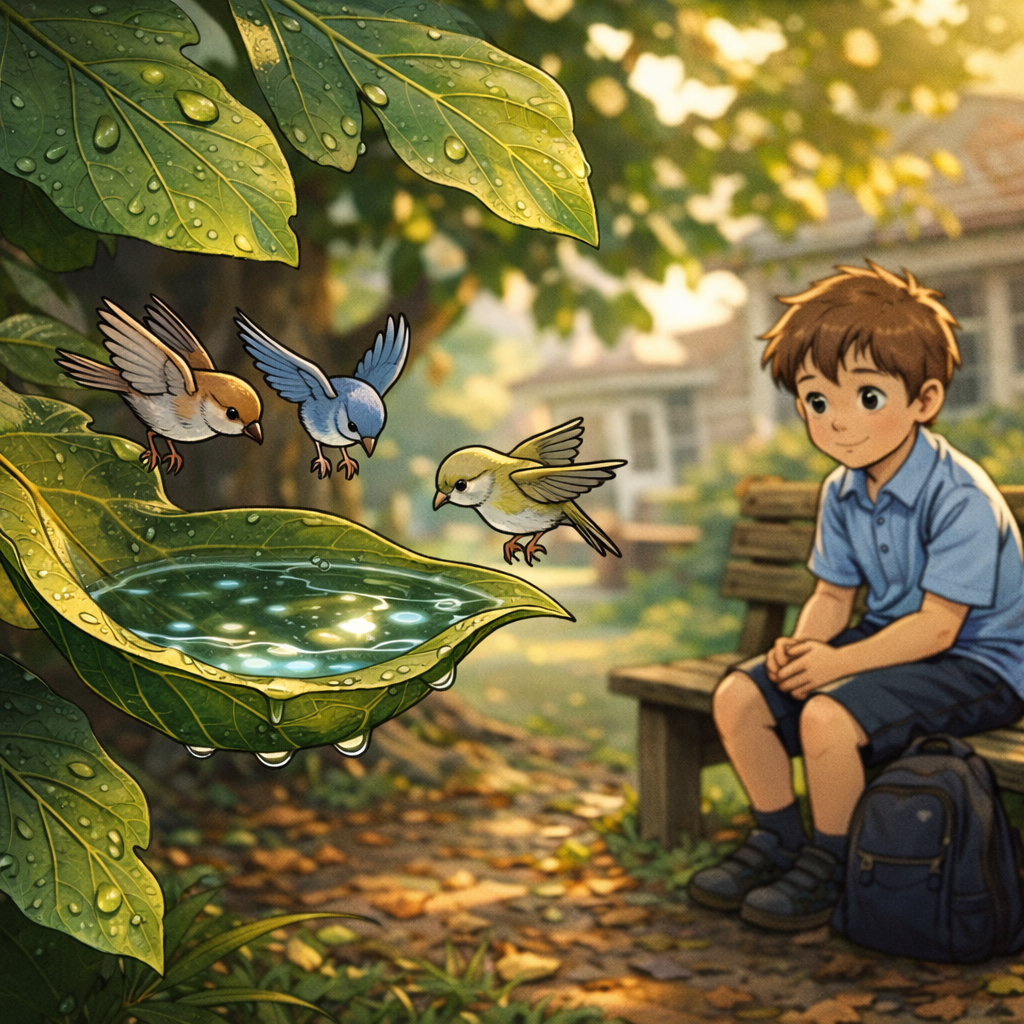
It was an old tree, broad and unhurried, the kind that had been there long enough to belong to the place the way walls and gates belong — not planted so much as arrived. It stood at the edge of the school entrance where the path met the garden, its large leaves catching the last of the afternoon light. Most of the water ran off those leaves, fell into the grass and dirt and disappeared without ceremony. But one leaf near the bottom had bent upward over the years into something like a bowl. Patient and curved, it had collected what the others let go. And even now, long after the sky had cleared and the other leaves had dried, it held.
Elliot sat on the low bench with his bag between his feet and his hands folded in his lap and watched the leaf hold its water.
His grandfather was late.
This did not worry him. His grandfather was sometimes late now. He was tired in a way that had started before the funeral and had not lifted since. Elliot understood this. He had seen it up close — the kind of tired that lives behind the eyes. His grandfather was learning, at seventy-three, how to be in a house that used to hold three people and now held two.
Elliot was learning the same thing. In a different way. At seven.
He had not thrown a single tantrum since his grandmother died. Had not caused a moment of trouble. He had simply continued — through the school days and the evenings and the nights that were sometimes long — carrying it the way she carried the grocery bags. Steady. Close to the body. Without letting them swing.
She had not taught him this in words. She had taught him by being someone who did it herself. Who absorbed rather than added. Who made rooms quieter just by entering them. Who had raised his father, and then when his father and mother died within a year of each other — the way these things sometimes happen — had raised Elliot too, without complaint, without making him feel like a burden, without ever once letting him sense the weight of what she had taken on.
She had been his grandmother.
She had also been, in every way that mattered, his mother.
He had lost his mother twice. Once before he could remember it. And once two weeks ago in a hospital room with the afternoon light coming through the blinds in pale strips and his grandfather holding one of her hands and Elliot holding the other.
He had felt the exact moment she let go.
He thought about this now, watching the fig leaf hold its bowl of water in the quiet after the rain. She had held on longer than the doctors expected. Longer than her body wanted to. And he believed — he would always believe — that she had waited. That she had known, somehow, when the moment was right. When letting go was not giving up but finishing.
He was still sitting with this when the birds came.
Three of them. Small and brown, the kind that were everywhere in gardens like this without ever being particularly noticed. They came to the fig tree, drawn by the water in the upturned leaf. They wanted to drink.
But the leaf was delicate. Every approach disturbed it. They came too fast and the water shifted toward the edge. They hovered too close and the leaf trembled. One landed on the branch beside it and the whole thing shook and the water nearly spilled and the bird retreated, startled.
Elliot leaned forward.
He watched them try. Again and again, each attempt slightly different, each one ending with the leaf trembling.
Then one of them slowed. Impossibly slow — hovering just above the leaf like a hummingbird, wings invisible with speed, body perfectly still in the air. And in that stillness it drank. Just enough. The leaf barely moved. The water held.
Elliot let out a breath he hadn’t known he was holding.
The other two watched. Then tried again — slower, finding their own stillness. One succeeded. Then the other.
Three small birds with no one to show them how, figuring out together, through patience and adjustment and the willingness to keep trying, how to take what they needed from the world without taking too much.
He sat back.
He was still holding this when he heard Mrs Jane’s voice behind him.
He did not turn around.
He knew her voice the way you know weather — its patterns and intensities, when it would pass and when it would settle in. She was speaking on her phone, and also to the corridor around her. Something about responsibility. About parents. About how a school was not an aftercare facility.
She could not go home. A child was still sitting outside and that was her responsibility and she wanted her evening and the grandfather’s old car had not yet appeared at the gate.
Elliot looked at the fig leaf.
The birds had finished. They were gone. The water was still there, mostly — they had taken only what they needed. The leaf held its shape. Undisturbed. Patient.
He heard Miss Lena’s footsteps. Quiet, familiar. She appeared at the classroom door and came to stand near the bench — not obviously between him and the corridor, just close. Present without demanding anything from him.
She was the only place in the school day that asked nothing of him and offered everything.
Mrs Jane’s voice continued. He could hear her pacing — heels on the corridor floor, phone in hand, the particular rhythm of someone performing impatience for an invisible audience.
She was his grandmother’s age.
Elliot breathed slowly.
He thought about his grandmother. About the last weeks, when she was tired in a way that went beyond tiredness — when her body had become something she was gently setting down, piece by piece, with the same quiet care she had given everything in her life.
She was tired, he thought. And she rested.
Then he heard his grandfather’s car.
He knew it before it turned through the gate — that engine, slightly rough, familiar as a voice. His whole body recognised it and something released.
He picked up his bag.
He stood.
And for the first time since he had sat down, he turned around.
Mrs Jane was in the corridor doorway. Tall, thin, phone in hand, expensive clothes, nine years at this school. This week she had told the staff they were no longer permitted to use the word friends when speaking to children.
Elliot looked at her the way he looked at fig leaves and small birds.
He saw a tired person.
It was not the tiredness of a long day. It was something older. Something rehearsed.
He took a breath.
He looked at her directly and said, quietly and without malice:
“My grandmother was also tired.”
The corridor did not move for a moment. Even the fluorescent lights seemed to hum more softly.
Then he turned and walked out toward the gate.
Mrs Jane stood very still, holding her phone.
Elliot reached the car. His grandfather was already out of it, tired and a little rumpled, his face carrying everything a face carries when it knows it is late and is sorry.
Elliot put his hand in his.
Just a small hand finding a large one. Steady. Close to the body. Without letting it swing.
Before he got in he turned, just slightly, toward where Miss Lena stood at the entrance.
He didn’t wave. Didn’t call out.
Just — quietly, so that only she could hear:
“Thank you.”
Then he got in the car. The door closed. The engine found its rhythm and the old car moved out through the gate and was gone.
Miss Lena stood at the entrance for a moment.
Then she went back inside.
Behind her, the fig tree dripped its last drops into the afternoon. A small bird returned, tested the leaf. It bent lower this time. A single drop fell to the soil.
The bird drank.
Elliot did not look back.
 WonderWhisper
Leave a comment