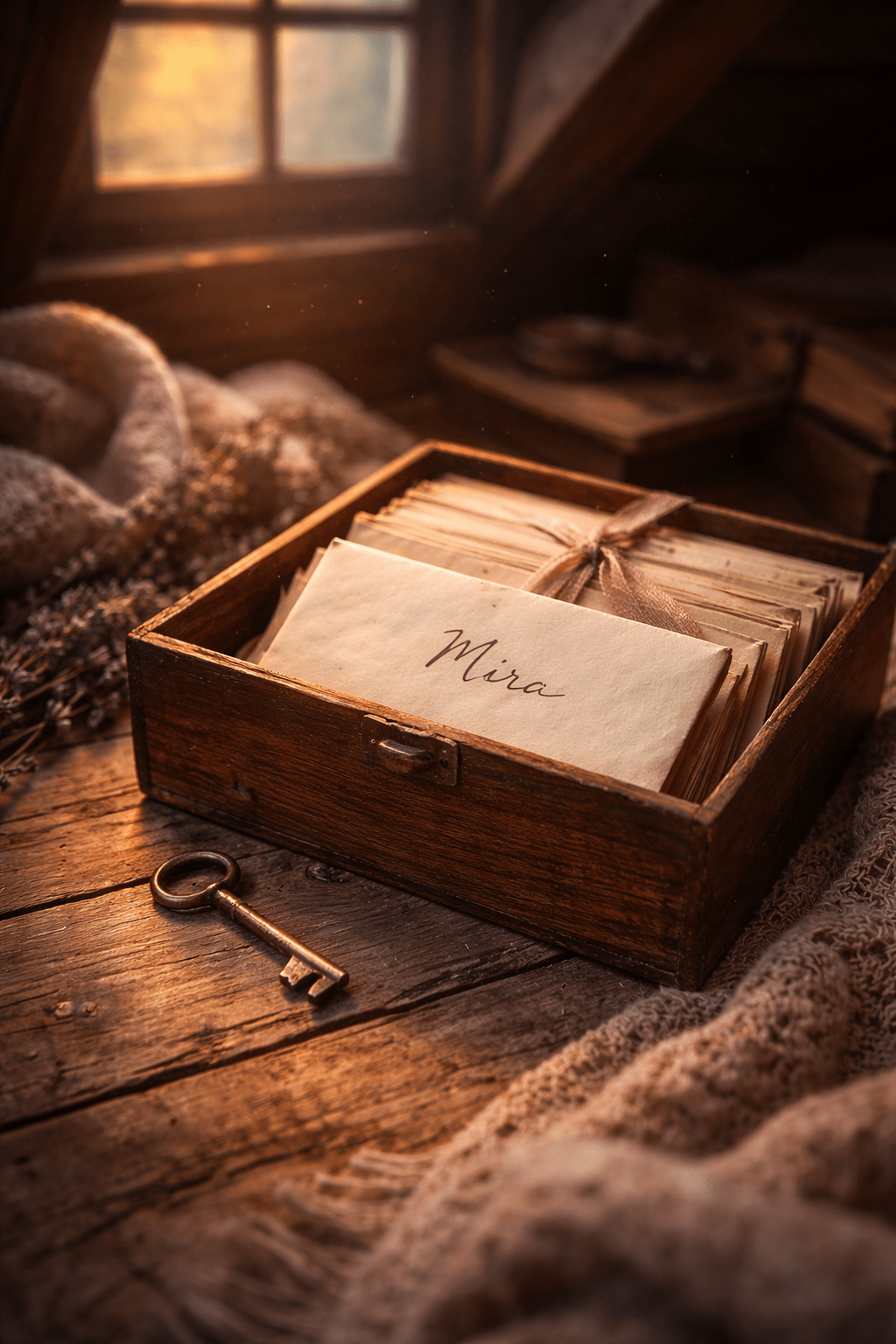
The lawyer’s letter had arrived on a Tuesday, which Mira would later think was appropriate. Nothing in her life had ever announced itself on an important day. Things simply appeared — quietly, without ceremony — on ordinary days when she was thinking about something else entirely.
The letter said she had inherited a house.
From a grandmother she had never met.
In a village in Spain she had never heard of.
She read it three times at her kitchen table, in the apartment that had never quite felt like hers, in the city where she had lived for six years without ever feeling she belonged to it. Then she folded it carefully, placed it back in the envelope, and sat for a long time in the particular silence of someone whose life has just shifted beneath them without making a sound.
Her mother, when told, said very little. Which was itself a kind of answer to a question Mira had been carrying for years.
She booked the flight alone.
The village was three hours from the airport, up into hills that grew quieter and older the further the road climbed. The driver spoke little. The afternoon light came through the window at an angle that turned everything gold. Mira watched the landscape change and felt something she could not name — not excitement exactly, not nerves exactly. Something older than both. Something her body seemed to recognise before her mind had caught up.
She had felt this before. Not often. Arriving somewhere for the first time and feeling, inexplicably, that some part of her had already been there. Most people dismissed this feeling. Mira had learned to dismiss it too. But sitting in that car, watching the hills, she let it stay.
The house was at the end of a narrow lane, behind a gate almost entirely hidden by roses.
She stood at the gate for a moment before opening it.
The roses were overgrown, unpruned, sprawling across the stone wall in every direction — red and pale yellow and a deep pink that was almost white. Beyond them she could see fruit trees, heavy and unhurried, and the stone facade of the house itself, weathered and quiet, its shutters closed, its windows dark.
It had been closed for two years. Since her grandmother died.
Mira put her hand on the gate.
Something in her chest went very still.
She pushed it open and walked in.
The relatives came the next morning — her father’s cousins, their children, neighbours who had known her grandmother for decades. They arrived with food and cleaning supplies and the particular warmth of people who have been waiting a long time to welcome someone home. They embraced her without awkwardness, as if they had always known her, as if she were simply someone who had been away and was now back.
One older woman held Mira’s face in both hands and looked at her for a long moment.
“You have his eyes,” she said softly. “Your father’s eyes.”
Mira did not trust herself to speak.
They cleaned for three days. Throwing open shutters, airing rooms, washing floors and windows and the heavy curtains that had kept the house in its long darkness. Layer by layer, the house came back to itself — the stone floors cool and pale beneath the dust, the kitchen with its old wooden table worn smooth by decades of meals, the garden slowly visible again as they cut back what had grown wild.
Mira worked alongside them, and as she worked she began to understand something she had no words for yet. Every room she entered felt, in some quiet way, as if it had been expecting her. Not waiting dramatically. Simply — patient. The way certain things are patient when they have been kept carefully for a specific purpose.
She found the key on the second day, in a drawer in the hallway.
It was small and brass and easy to miss. She almost dropped it into the bin bag without thinking. Something made her stop. She turned it over in her fingers. Then she placed it on the windowsill, where the afternoon light found it, and left it there.
She wasn’t sure why.
She just knew she wasn’t ready to throw it away.
The attic was the last thing.
She climbed the narrow stairs on the fourth day, alone, the relatives having gone home for the evening. The attic smelled of old wood and something sweet she couldn’t identify — dried herbs perhaps, or flowers, or simply the accumulated scent of years of careful living. Light came through a small window, pale and dusty.
Against the far wall stood a narrow wooden cabinet.
She tried the key.
The lock turned.
Inside, wrapped in a cloth the colour of old roses, was a box. And inside the box — envelopes. Dozens of them. Perhaps more. She lifted the first one and read the name on the front.
Her father’s name.
Then another. And another. And then — halfway through — the name changed.
Her own.
Her hands went still the way hands go still when the body understands something before the mind does. She stood in the quiet attic holding an envelope addressed to her, in handwriting she had never seen, and felt something move through her that had no name in any language she knew.
She sat down on the floor. The cold came through her jeans immediately. The cloth that had wrapped the box smelled of lavender — faint, old, unmistakable. Outside, somewhere in the village, someone was cooking. The smell of it drifted up through the window, warm and ordinary.
She began at the beginning.
The first letters were written to her father, Yusuf.
A mother writing to a son she had lost — not to death, not yet, but to distance and silence and the particular cruelty of a life that had moved him beyond her reach. The early letters were careful, measured, trying not to ask for too much. Mira could feel it in the handwriting itself, in the way sentences started boldly and then softened, as if the writer kept catching herself.
My dear Yusuf. I hope you are well. The roses are blooming early this year. Your uncle asks about you.
Mira learned her grandmother’s name from those letters. Fatima. A name her father had never once spoken in her presence.
The letters grew more honest as the years passed. The careful distance narrowed. A mother’s real voice came through — the longing, the questions she could not quite ask directly.
Do you think of coming home? Even once. I would not ask for more than once.
Then, in a letter dated the year Mira was born, everything shifted.
I heard about the child. A girl. I lit a candle when I found out and sat with it until it burned down. I do not know her name yet. I do not know if I am allowed to love her. But I have decided that love does not require permission to exist, even when it requires permission to reach.
I am going to write to her. In the same box. I hope one day she finds it. I hope one day someone puts the key in her hand.
Mira set the letters down.
She looked around the attic — the low ceiling, the pale window, the dust suspended in the last of the evening light. Her father had grown up in this house. Had run through this garden. Had perhaps sat in this same attic as a boy, not knowing that one day his mother would sit here for twenty-five years writing letters to a granddaughter she would never meet.
She picked up the next envelope. Her name on the front.
She kept reading.
The letters to Mira began the way you begin a conversation with someone you love but cannot see.
Her grandmother wrote about ordinary things. What was growing in the garden that week. What the village was cooking for the festival. The way the light fell on the hills in October, different from any other month, amber and heavy and slow. She wrote about her own childhood — a family who cooked together on Sundays, a father who told stories, a mother who kept roses the way other people kept secrets, carefully and with great tenderness.
She wrote about Yusuf as a boy — serious and quiet, carrying more than a child should carry, making his mother laugh when she needed it most without knowing that was what he was doing. She wrote about watching him leave and the way the house felt different after, not empty exactly, but listening. Waiting for footsteps that didn’t come.
I talk to you every day, she wrote, in a letter from the year Mira turned twelve. I wonder what you look like now. I wonder what you like to eat. I hope someone is teaching you to cook. I hope someone is telling you that you come from people who loved each other very much, even when the world made it difficult.
I hope you know you are not alone. Even if it feels that way. Even if no one has told you.
After Yusuf died, the letters changed.
The carefulness was gone entirely. She wrote the way people write when time has become something precious and finite — directly, warmly, without apology.
Everyone thinks I am fine, she wrote. And I am fine, most of the time. I am loved here. The relatives come. The neighbours’ children call me auntie and eat everything I put in front of them. But there is a kind of missing that doesn’t show. It sits beside you quietly, the way a person would, and you learn to set a place for it at the table.
That is what you are, my dear. Not a wound. Just a presence I make room for.
She wrote through her illness. Through the slow winters. Through the years when the garden grew and the roses climbed and the village continued its ordinary beautiful life around her. She wrote about regret — not with bitterness, but with the hard-won wisdom of someone who had learned to carry it without being crushed by it.
Do not spend your minutes on regret, she wrote, in one of the last letters. I spent too many of mine. The people who love you do not leave when they leave. They stay in the walls of the places they lived, in the smell of the gardens they kept, in the letters they wrote to wooden boxes in the hope that one day the right hands would find them. Love does not require presence to be real. I am proof of that.
You belong to me, my dear. You have always belonged to me. Even when neither of us knew it.
The last letter was short.
If you find these — hello. I am so glad you exist. I have celebrated your birthday alone in my kitchen every year with a small cake I eat myself. I have talked to you every day for twenty-five years. You became real to me across these pages in a way I cannot explain.
You were loved before you knew I existed.
Take care of yourself.
Your grandmother, Fatima.
Mira sat in the attic until it was fully dark.
She did not cry immediately. She sat with the letters in her lap and the lavender-scented cloth beside her and the small brass key still in her hand, and felt something she had no name for — something between grief and gratitude, between loss and an impossible, unexpected fullness.
She thought about her mother’s world — the cold beautiful apartment, the careful distances, the feeling of being present in a life that was never quite hers. She thought about the years of feeling like an outsider in her own existence, of moving through the world like someone who had arrived at a party where everyone else seemed to know each other and the host could not quite remember inviting her.
She had spent her whole life not knowing she belonged somewhere.
It turned out she had — here, in this stone house behind its roses, in this village that had felt right the moment the car turned into the lane, in the hands of a woman who had talked to her every day for twenty-five years across a silence neither of them had chosen.
When she finally stood and walked to the attic door, something had changed in the quality of the air around her. She could not explain it. She was not someone who explained such things easily. But she felt accompanied — by a warmth that had no source in that cold room, by a presence she had never met but somehow already knew.
Her grandmother had spent years in this attic, writing to a wooden box.
Now Mira carried her out of it.
Down the narrow stairs, through the kitchen that smelled of old wood and decades of cooking, out through the back door into the garden where the roses were dark shapes against the night sky and the fruit trees stood heavy and still and the air smelled of earth and something flowering she could not name.
She stood in the garden for a long time.
Above her, the stars were very clear.
She looked down at the key in her palm.
Small. Brass. Warm from her hand.
It had waited a long time.
So had she.
 WonderWhisper
Leave a comment