It was an ordinary afternoon in an unordinary place — that kind of ground between a playground and the woods where the grass gives up and the earth takes over, where roots push through the surface and stones appear without explanation, as if the ground is quietly offering things up.
She was not looking for anything.
That is always how it starts with the things that matter most. You are not looking. You are simply moving through the world, half-present, half-elsewhere — and then something catches the corner of your eye and you stop.
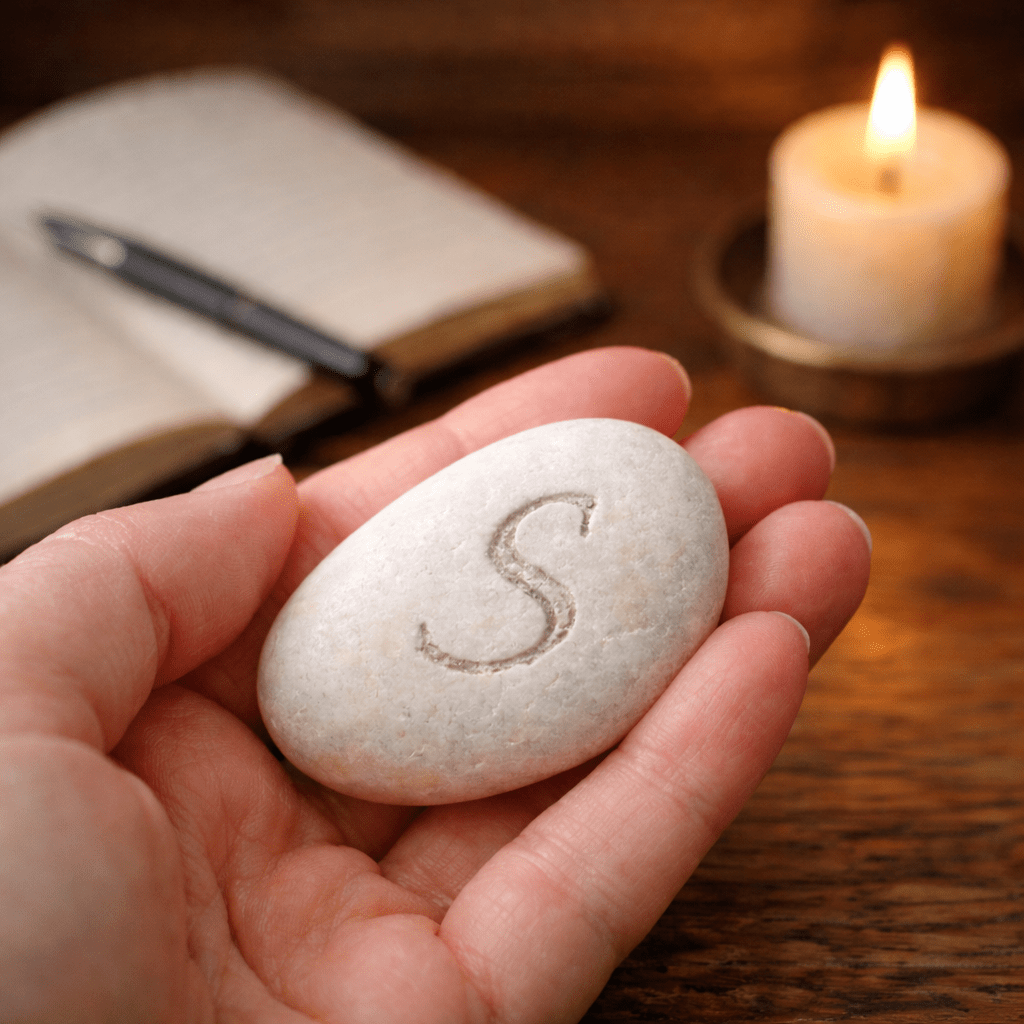
It was white. That was the first thing. White and smooth and slightly oval, small enough to close a fist around, shaped the way certain things are shaped when something patient and unhurried has been working on them for a very long time. It sat in the dirt as though it had always been there. As though it had been placed.
She picked it up.
It was cool against her palm. Heavier than it looked — not heavy like a burden, but heavy like something solid, something real, something that has been somewhere long enough to carry the memory of it. She turned it over once.
And stopped.
There, on the underside of the stone, was a letter.
Not scratched roughly. Not painted or marked by human hands. Carved, somehow, by time and pressure and the slow patient work of the earth itself — faint but unmistakable, the way certain things are unmistakable even when you cannot explain why.
Her initial.
The first letter of her name.
She stood very still.
She knew, of course, that nature does this. That water traces lines in stone over centuries. That roots press shapes into rock. That the earth is always writing in a language most people walk past without reading. She knew there was an explanation.
But knowing the explanation and feeling the thing are two entirely different experiences.
She felt, standing in that in-between place where the playground ended and the woods began, that the stone had not been found. That she had been led to it. That it had been here — this cool white oval with her letter on it — waiting in the particular patient way that only stones can wait, for her, specifically, to come along and pick it up.
She put it in her pocket and walked home.
That was three years ago.
The pebble lives in a drawer now. Not hidden — just resting, the way it rested in the earth before she found it. Beneath a few other small things, slightly to the left, exactly where she always knows it is without having to look.
She doesn’t take it out often.
But she knows when she needs to.
There are days — everyone has them, though not everyone admits it — when the world feels too loud and the inside of her own head feels louder. When something goes wrong that she didn’t see coming, or when nothing goes wrong exactly but the weight of ordinary life accumulates quietly until it is no longer ordinary. When she lies awake at two in the morning having a conversation with herself she would rather not be having.
On those days, sometimes, she opens the drawer.
She doesn’t always look at it. Sometimes she just picks it up and holds it — closes her fingers around its smoothness, feels the cool weight settle into her palm, and stays there. Just stays. Not thinking about the letter on its underside. Not thinking about what it means or doesn’t mean. Just holding something that has been held by the earth for longer than she can imagine, and feeling, through that contact, something she can only describe as calm.
It is not magic. She would not call it magic.
But it is something.
There is a particular feeling that cold smooth stone gives to anxious hands. Cooler than the body, always, no matter how long you hold it. Something about that steadiness — the weight, the smoothness, the temperature that never quite warms — that gives the hands something real when everything else feels uncertain. It does what words sometimes cannot.
She thinks it has something to do with age.
The stone is old. Older than her problems. Older than the things she lies awake worrying about. Older than the house she lives in, the street it stands on, the century she was born in. When she holds it she is holding something that existed before any of this — before the noise and the speed and the particular exhaustion of being alive in this particular time — and something about that perspective, felt through the palm rather than reasoned in the mind, makes the present moment smaller. Makes it more manageable. Makes it, somehow, okay.
She has never told many people about the pebble.
Not because it is a secret. Just because some things are difficult to explain without sounding strange, and she has learned that the things most worth keeping are often the ones most difficult to explain.
But she thinks about what it means — that nature does this. That the earth writes letters and carves faces and traces names into stone without knowing who will find them, without knowing if anyone will. The woods are full of these things. Stones with shapes that look like hands, or hearts, or letters. Trees with patterns in their bark that look like eyes or maps or memories. The earth makes them anyway, indifferently, patiently, over centuries.
And then one afternoon, someone stops.
Someone who was not looking for anything picks up a small white stone in a patch of ground between a playground and a wood, turns it over, and finds their own initial looking back at them.
And something happens in that person that cannot be explained but also cannot be denied.
She still has the stone.
On the hard days she opens the drawer, picks it up, and breathes. The breathing slows. The world, for a moment, quiets.
She does not know if it was waiting for her. She does not know if the earth meant anything by it.
But after three years she has stopped needing to know.
Some things do not need to be explained to be true. Sometimes the earth leaves something in your path — cool and white and smooth, marked with the first letter of who you are — and all you have to do is be paying just enough attention to pick it up.
And keep it.
And know it is yours.
 WonderWhisper
Leave a comment