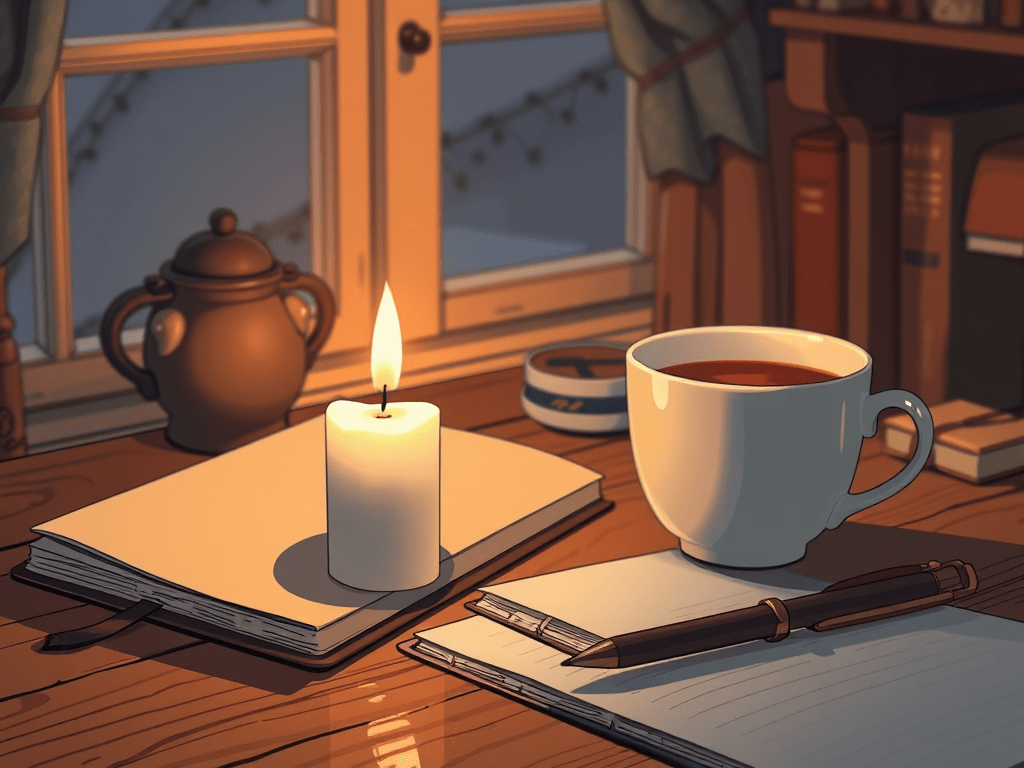
It was not the kind of candle anyone would notice.
No particular height. No scent worth mentioning. Just a small white candle on a wooden desk in a small study, its flame no bigger than a thumbnail, burning with the quiet steadiness of something that had decided, without fuss, to simply do what it was made to do.
On the shelf nearby stood taller candles — broad, decorative, the kind bought to impress. They cast dramatic shadows when lit. When guests came, someone always pointed at them.
The small candle on the desk was never pointed at.
It didn’t mind.
It had work to do.
The writer who sat at that desk was named Lena. She was twenty-nine, and she had been trying to finish the same story for eleven months. Not for lack of trying. She came to the desk most nights, made tea, opened the notebook, and sat in the particular silence of someone waiting for something they are not sure will come.
Some nights it came. Words arrived and the pen moved and an hour passed like ten minutes.
Other nights she sat until midnight and wrote nothing, or wrote things she crossed out immediately, and went to bed feeling like a person who had chosen the wrong life.
Her closest friend Mara had stopped asking how the story was going. Not unkindly — she simply understood, the way certain people understand without needing to be told, that the question had started to land like a small bruise. Instead, Mara would text on quiet evenings: still at the desk? And Lena would reply: still here. And that was enough. That was, in fact, more than enough.
But one evening in January — cold enough to make the whole world feel farther away than usual — even that felt insufficient.
Lena sat at the desk and read back the last three pages she had written. Then she closed the notebook.
Not dramatically. Not with a decision attached to it. She simply closed it the way you close something when you can no longer see the point of it being open. She sat in the dark for a moment. She thought about the eleven months. About the story that had seemed, once, like the truest thing she had ever tried to say, and now seemed like evidence of something she didn’t want to name.
She almost didn’t light the candle.
Her hand moved toward it out of habit, then stopped.
Then, slowly, continued.
The match caught. The flame steadied. The small circle of light fell over the closed notebook, the cooling tea, the pen resting where she had set it down.
She looked at it — just a glance — and something in the quality of its light did something she couldn’t have explained. Not dramatic. No sudden clarity. But the tightness in her chest loosened very slightly. Her shoulders dropped half an inch.
She opened the notebook.
She wrote one sentence. Just one — small and uncertain, the kind that doesn’t know yet if it belongs anywhere. Then another. Then another. She wrote until the candle had burned down a third of its length and the tea had gone cold and the January dark outside had stopped feeling like an accusation.
The story, which had been silent so long she had almost stopped believing in it, began to speak again in its own quiet voice.
She did not know, that night, that what she was writing would matter. She would not know for some time. But the story she found in that small circle of candlelight — on the night she had almost not lit the candle, on the night she had almost closed the notebook for good — was the one that would eventually reach someone who needed it. Someone sitting alone somewhere, reading it and feeling, for the first time in a while, a little less alone in whatever they were carrying.
The candle knew none of this.
It simply burned.
Night after night, Lena lit it. It became part of the ritual — the tea, the notebook, the match, the small steadying flame. She stopped noticing it consciously the way you stop noticing the things that hold you. But on the nights when the doubt returned hard, when the voice said this is going nowhere, you are going nowhere — she would look at the candle and feel something she couldn’t quite name.
Not hope exactly. Steadier than hope.
Something more like company.
The candle burned down eventually. As candles do. One night she struck the match and touched it to the wick and nothing caught — just a thread of smoke curling upward and then gone.
She sat looking at the dead wick for a long moment.
Then she thought of something. She got up, went to the shelf where the tall decorative candles stood, and took one down. It was too large for the desk really, slightly absurd next to the notebook and the small teacup. She lit it anyway.
The flame was the same.
Steady. Quiet. Falling across the page in the same unhurried light.
She almost laughed.
Then she picked up the pen and wrote.
She wrote until the story found its end, or something close enough to an end for that night. When she finally set the pen down, she noticed the large candle had left a wax ring on the desk — pale and permanent, a small mark she would have to deal with in the morning.
She looked at it for a moment.
Then she went to bed and left it there.
 WonderWhisper
Leave a comment