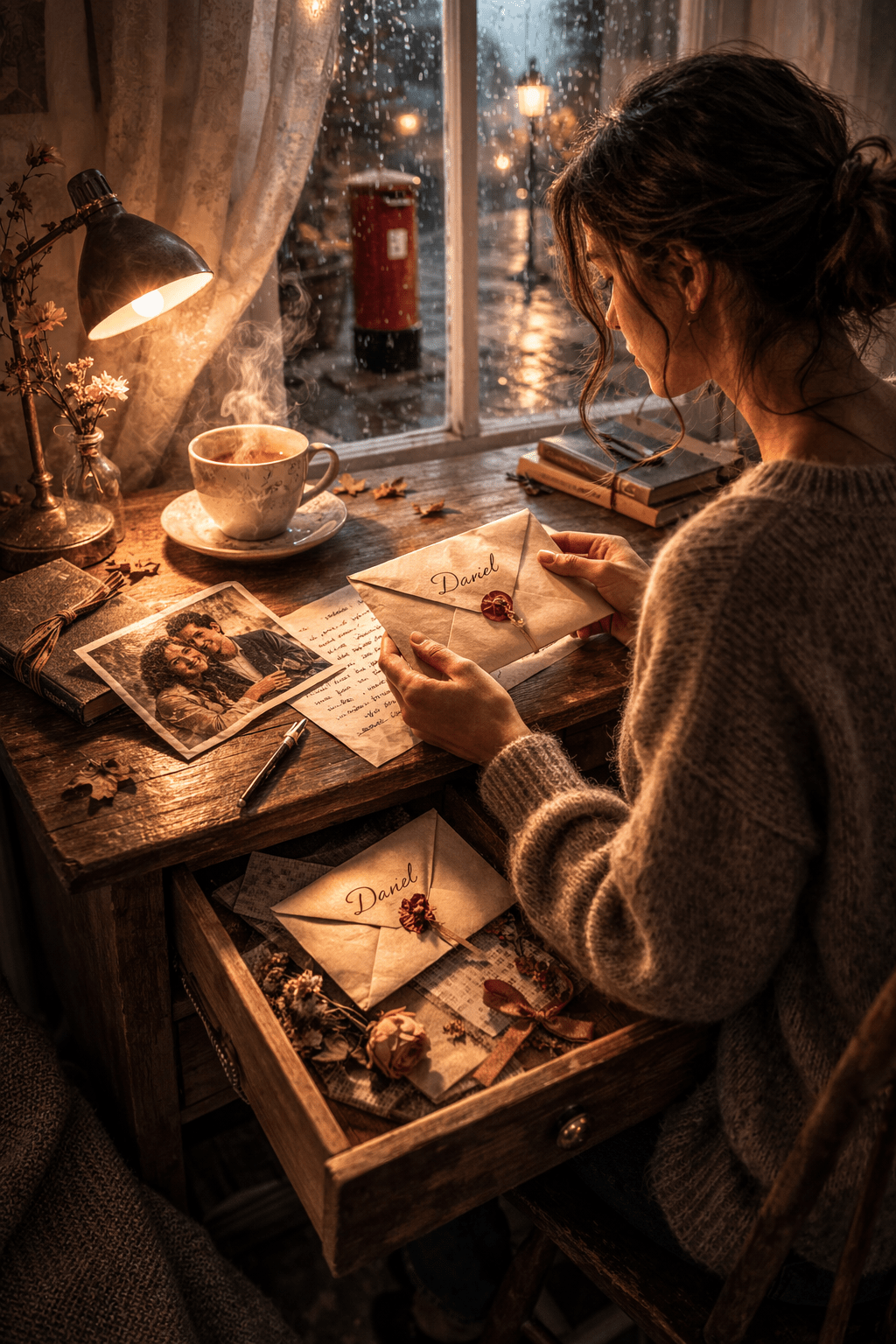
Nadia had not cried in a long time. She considered this a kind of progress.
Then one Tuesday night in November she found an old photograph while looking for something else — nothing dramatic, just a moment caught in light, the two of them at a table somewhere, both laughing at something the camera hadn’t caught. She stood in the hallway holding it, and then she sat down on the floor and stayed there until the feeling passed.
It took a while.
Afterward, she went to her desk and wrote the letter.
Two hours. Writing and crossing out and writing again, until the words finally held the shape of what she meant. The apologies she had delayed too long. The gratitude she had never said aloud. The forgiveness she hoped might still be possible — for both of them. When she finished, she read it through once. Then she sealed the envelope, wrote the name on the front — his name, which she had not written or spoken in three years — and placed it carefully in the top drawer of her desk.
She told herself she would send it in the morning.
That was eleven months ago.
The letter was still there.
She knew exactly where it sat — beneath a notebook, slightly to the left, the envelope soft at the corners now from the times she had taken it out and held it and put it back. She had not opened it again. She didn’t need to. She remembered every word.
The months had not been empty. She had carried the letter the way you carry something you are not ready to put down — aware of its weight at odd moments, on the bus, in the middle of conversations, standing in line at the market. Sometimes she would be laughing at something and then remember it, and the laughter would not stop exactly, but it would change slightly, become a different thing.
She had thought about him more than she expected. Not always with pain. Sometimes with something gentler — a memory of the way he mispronounced certain words and refused to be corrected about it, the particular way he made coffee, too strong for anyone else, the look on his face when he was genuinely surprised by something, which was rarer than it should have been.
She had also thought about what she had written. Whether it was fair. Whether the apologies were the right ones, whether she had understood correctly what had needed forgiving and what had simply needed time.
Some nights she imagined sending it. She would lie in the dark and picture him opening it — reading it slowly, setting it down on a table somewhere she had never seen, in a life she knew nothing about now. She didn’t know what his face would do. That uncertainty was part of what kept the letter in the drawer.
The other part was harder to name.
One evening in October, almost a year after she had written it, Nadia opened the drawer.
She took the letter out and held it. The envelope was lighter than it felt. She turned it over once, looking at his name in her own handwriting — careful, almost ceremonious, as if she had known even then that the writing of it mattered more than the sending.
She put on her coat.
She was not entirely sure why. Her hands had simply done it, the way hands sometimes act before the mind has decided anything. She picked up the letter. Walked to the door. Stood there with her hand on the handle, the envelope pressed between her palm and her coat.
Outside, the street was quiet. The post box was at the corner — she could see it from the step, red under the lamplight, patient as everything patient is.
She stood in the doorway for a long time.
Then she went back inside.
She took off her coat. Sat at her desk. And unfolded the letter.
The words were still true.
Every one of them.
But something had shifted in her — quietly, without announcement, the way most important things shift. She read the apologies and realized she had already made them, somewhere inside herself, in the eleven months of carrying this envelope around like a question she was afraid to answer.
She read the part about forgiveness and understood, with a clarity that surprised her, that she was no longer waiting for his.
She had already given herself something she hadn’t known she needed.
Nadia folded the letter. Slid it back into the envelope. Held it for a moment longer.
Then she placed it back in the drawer and closed it.
Not because she had given up.
Not because the words no longer mattered.
But because they had already done what they came to do — in the writing, in the waiting, in the eleven months of learning to carry something honestly instead of pretending it wasn’t there.
She made tea and sat by the window.
The street below was quiet. A light rain had started, soft and unhurried, nothing like the night she had written it. A woman walked past quickly, head down, going somewhere. Nadia watched her and thought — she doesn’t know. Nobody walking past this window right now knows. And that was fine. Some things don’t need witnesses to be real.
She sat with her hands around the warm cup and felt, for the first time in a long time, that she was not waiting for anything.
The letter stayed in the drawer.
It stayed there the way certain things stay — not forgotten, not unfinished, but complete in a way that had nothing to do with being sent. A record of a night she had finally stopped pretending. A document of something true, written by someone who had needed to write it, read by the only person who had needed to read it.
Herself.
Some letters are written to reach someone else.
And some are written to find your way back to yourself.
 WonderWhisper
Leave a comment