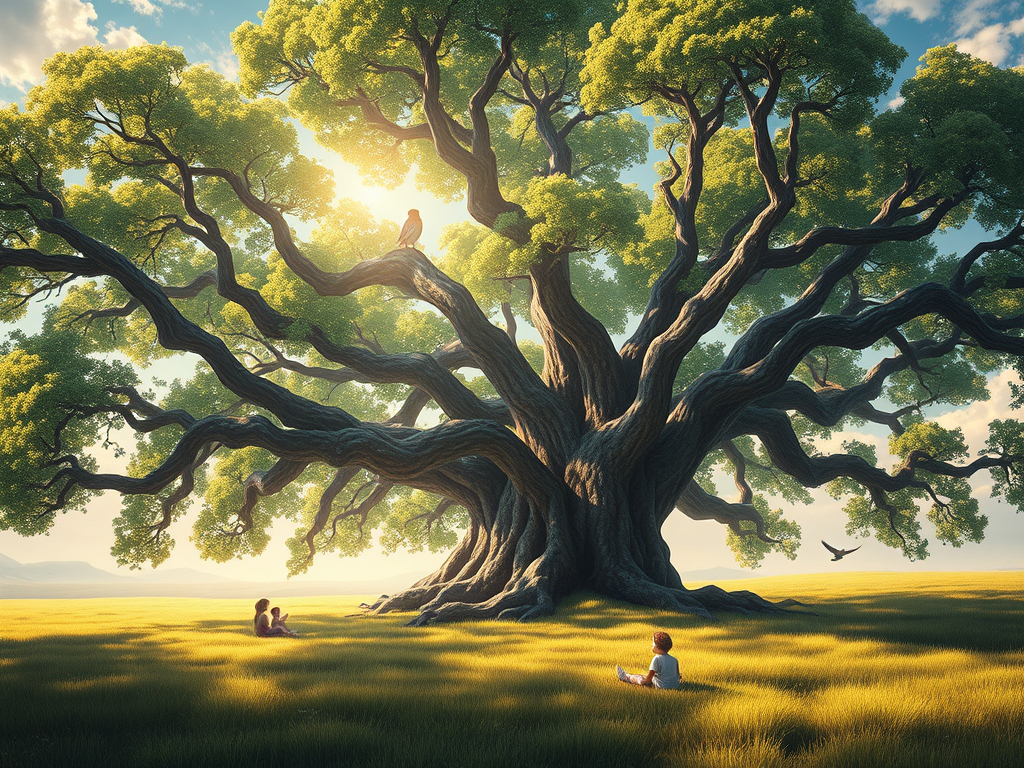
At the edge of a windy coast, where the land met the sea and the sky felt wider than anywhere else, there was a field with two trees.
The first was an oak — old, broad, and unhurried. Its roots had grown downward so long that no one alive remembered when it had been young. Its bark was rough and weathered, carrying the marks of every season it had survived. It didn’t stand in the field so much as belong to it.
The second was a pine — young, slender, and full of certainty. Its needles were sharp and bright, its trunk smooth and proud. It had not yet lived through enough winters to know what winters could do.
They stood close enough to talk, those two trees.
And one autumn morning, as the first cold wind swept in from the sea, the pine straightened and announced:
“I will never bend. Strength means standing firm. If the wind comes, I will not move.”
The oak was quiet for a long moment.
Then it said, simply: “The wind is coming.”
The pine didn’t understand. It thought the oak was agreeing.
Winter arrived earlier than expected that year.
The storms came one after another, rolling in from the coast like they had something to prove. Rain. Ice. Wind that didn’t ask permission before it pushed and pulled and roared across the open field.
The pine was ready.
Every time the wind came, it held itself rigid — every branch tight, every needle stiff, its whole body one long act of refusal. It was proud of itself. It did not move. It would not bend.
The oak did something different.
When the wind pushed, the oak leaned. Not dramatically, not helplessly — but enough. Its branches swayed. Its great body curved into the gust and then, when the gust passed, slowly rose again. Like breathing. Like something that understood the difference between giving way and giving up.
The pine watched this and thought the oak looked weak.
Then the worst storm came.
It arrived in the night, when the field was dark and the sea was loud and no one was watching. The wind hit the coast like something enormous and impatient. It tore across the field and found the two trees.
The pine held firm.
And snapped.
Not slowly. Not gently. Clean through — a sound like the world cracking open — and then silence, and then the long creak of falling, and then nothing.
The oak swayed so deeply it nearly touched the ground. Its oldest branches groaned. Its roots gripped the earth the way a hand grips something it refuses to release. The wind screamed past it, furious and unstoppable.
And then the wind was gone.
And the oak rose.
Slowly. Unevenly. A little more curved than it had been before. But upright. Alive. Still here.
Spring came the way it always does — quietly, without announcement, as if it had simply been waiting just out of sight.
The field changed. Grass grew back. Birds returned. The sky softened from grey to blue.
But where the pine had stood, there was only a broken stump.
The oak stood alone now. It was not the same shape it had been before the storm. It leaned slightly, the way old things sometimes do when they have survived something enormous. Its bark was scarred in places. One of its lower branches had a long crack that had healed over slowly, leaving a ridge like a scar on skin.
It was not a perfect tree.
It was simply alive.
That spring, a grandfather walked the field with his grandson — a small boy of about six, who noticed everything.
The boy stopped in front of the oak and stared at it for a long time.
“Why is it crooked?” he asked.
His grandfather came and stood beside him. He looked at the tree — at the lean of it, the scars, the way it curved as if mid-bow, as if it had once nearly touched the ground and chosen, at the last moment, to rise.
“Because it survived,” the grandfather said.
The boy tilted his head. “But shouldn’t strong things stay straight?”
The grandfather was quiet for a moment. He was thinking of his own life — of the years that had bent him, the losses he had bowed beneath, the mornings he had risen slowly, unevenly, more curved than before but still standing.
“Sometimes,” he said gently, “staying straight costs too much.”
The boy didn’t fully understand yet. But he reached out and pressed his small palm flat against the oak’s rough bark, the way children touch things they sense are important.
The tree was warm from the morning sun.
He kept his hand there for a moment.
Years passed.
The oak kept growing — not up so much as outward, wider and steadier, its roots pushing further into the earth with each season. Birds found its branches and built small, careful homes there. In summer, children lay in its shade and looked up through its leaves at the sky. Old people came and sat with their backs against its trunk, the way you lean against someone you trust.
The wind still came, of course. It always does.
But the oak no longer braced against it. It simply bent when bending was needed, and rose again when the storm passed — the way it had always done, the way it had learned at great cost, the way it would continue to do for as long as it stood.
It had a curve now, a lean, a slight bow to the south where the worst storms had come from. It was not symmetrical. It was not what anyone would draw as a perfect tree.
But it was still there.
And there is something about a tree that has survived — really survived, bowed and scarred and leaning — that a perfect, unbroken tree can never offer.
It tells you something without words.
It tells you that bending is not the same as breaking.
That survival sometimes leaves marks.
That strength is not always what stands the straightest.
Sometimes, strength is the one still standing.
The boy who had pressed his hand against the bark grew up.
He had his own storms. His own winters. Moments when the wind hit him and he had to decide — hold rigid and risk breaking, or bend and trust that he would rise again.
On the hardest days, he thought of the oak.
He thought of the curve in its trunk, the scar along its branch, the way it stood in that field — imperfect, unhurried, deeply rooted, and quietly, unmistakably alive.
And he bent.
And rose.
And that was enough.
 WonderWhisper
Leave a comment