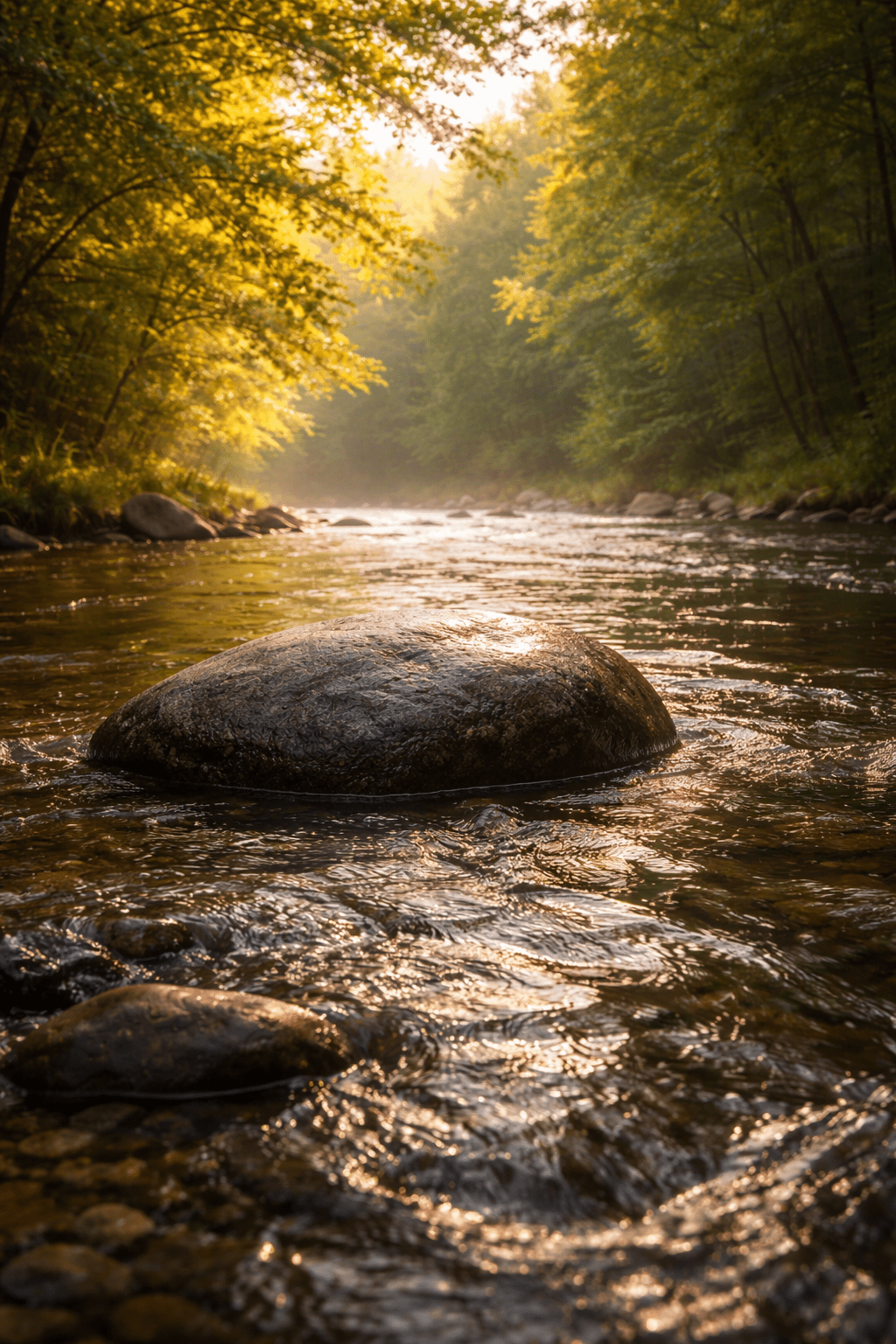
There is a river that runs through a quiet valley, and in the middle of it sits a stone.
Not a remarkable stone. Not large or glittering or unusual in any way that would make you stop and look twice. Just a smooth gray stone, worn flat on top, planted in the riverbed the way certain things plant themselves — without announcement, without apology, simply there.
The river moves around it every day.
It has been doing so for longer than anyone can remember.
The stone was not always still.
There was a time — long before any of it — when the stone was part of a mountain. Sharp-edged. Restless. Held in place by nothing but the weight of everything above it.
Then one day, the mountain let go.
The falling was violent. Terrifying. The stone cracked loose and tumbled through cold air and crashing rock, striking other stones, spinning without control, landing hard in the riverbed with a force that shook the water around it.
It lay there, jagged and raw.
The river came.
And kept coming.
Day after day, year after year, the water pressed against every sharp edge. Every rough corner. Every place where the stone had been broken open and left unfinished.
“Come with me,” the river said, in the way rivers say things — not with words but with constant, patient, irresistible pressure. “Everything moves eventually. Even mountains. Even you.”
The stone felt the pull.
Some mornings it felt it deeply — the seductive logic of simply letting go, of being carried somewhere new, of stopping the effort of staying.
“You’re wasting yourself here,” the river said. “I’ve seen a thousand stones like you. The ones who let go — they travel. They see things. They become part of something larger.”
The stone said nothing.
But it thought: I have already fallen once. I know where that leads.
It stayed.
The children found the stone on a summer afternoon — by accident, by instinct, by the particular courage of bare feet on wet rocks.
A girl named Sara stepped onto it first. She was seven, gap-toothed, more confident than she had any right to be. Her arms flew out for balance. She looked down at the water rushing past her feet and then back at the others with a grin that said: come on, it holds.
One by one they crossed. Hopping from the bank, landing on the stone, leaping to the other side. Shrieking at the cold spray. Laughing the way children laugh when they discover something they didn’t know they needed.
The stone felt every footstep.
Small and tentative. Bold and heavy. Sara’s quick and certain.
It held them all.
Not because it was the strongest thing in the river. The river was stronger — it always had been. But the stone had learned something the river, for all its power and distance and beauty, had not.
Years passed.
Sara grew. She stopped coming to the river for a while — there were years of school and noise and the particular busyness of becoming. But she came back, the way people come back to things that held them when they were small.
She would sit on the bank and look at the stone and feel something settle inside her.
It was still there.
That was enough.
Then the storms came.
Three days of rain without pause. The kind that makes you wonder if the sky has simply decided to empty itself of everything it has been holding back.
The river changed.
Not gradually. The change came fast — an ugly darkening of the water, a rise in the sound from murmur to roar. Branches came through like weapons. The gentle current became something thick and furious and indifferent.
“Now,” the river said, and there was no patience in it anymore. No philosophy. Just force. “Now you move.”
The water rose.
The stone felt the pressure differently this time — not the familiar daily push but something that found every edge, every weakness, every place it had been cracked in the falling and never quite fully healed. Sand scraped beneath it. The riverbed itself seemed to shift. For one long moment — a moment that stretched like something being pulled to its limit — the stone felt itself tilt.
Just slightly.
Just enough to know it was possible.
The river roared.
The stone held its breath, if stones can be said to do such a thing.
It thought of the mountain. Of the falling. Of how it had survived something that should have ended it, and landed here, of all places, and been slowly worn into something that children trusted with their weight.
It pressed down.
The riverbed gripped back.
The moment passed.
The water rose higher still — over the stone, past it, swallowing it completely. For days the stone was invisible, unreachable, gone as far as anyone standing on the bank could tell.
The river had won, it seemed.
Then the rain stopped.
The water dropped slowly, reluctantly, the way the river gives back what it has taken.
And there — in the center of the river — the stone reappeared.
Smaller than it had been, perhaps. A little lower. But when the sunlight found it, it gleamed. All the mud washed clean. Every rough place polished. Bright in a way it had never quite been before.
Sara came back when the path was dry enough to walk.
She stood at the bank for a long time before she stepped on.
The stone held.
She stood there in the middle of the river, water rushing past her feet, and she was seven again and thirty-one at the same time, and something in her chest cracked open in the good way — the way things open when they recognize something true.
She stepped off on the far bank.
Turned back and looked at the stone.
Still there.
Still exactly where it had always been.
The river moved around it, as it always had, quiet now, almost gentle, as if the argument had been settled at last.
Maybe it had.
The stone gleamed in the afternoon light.
It had not gone anywhere.
It had not needed to.
 WonderWhisper
Leave a comment