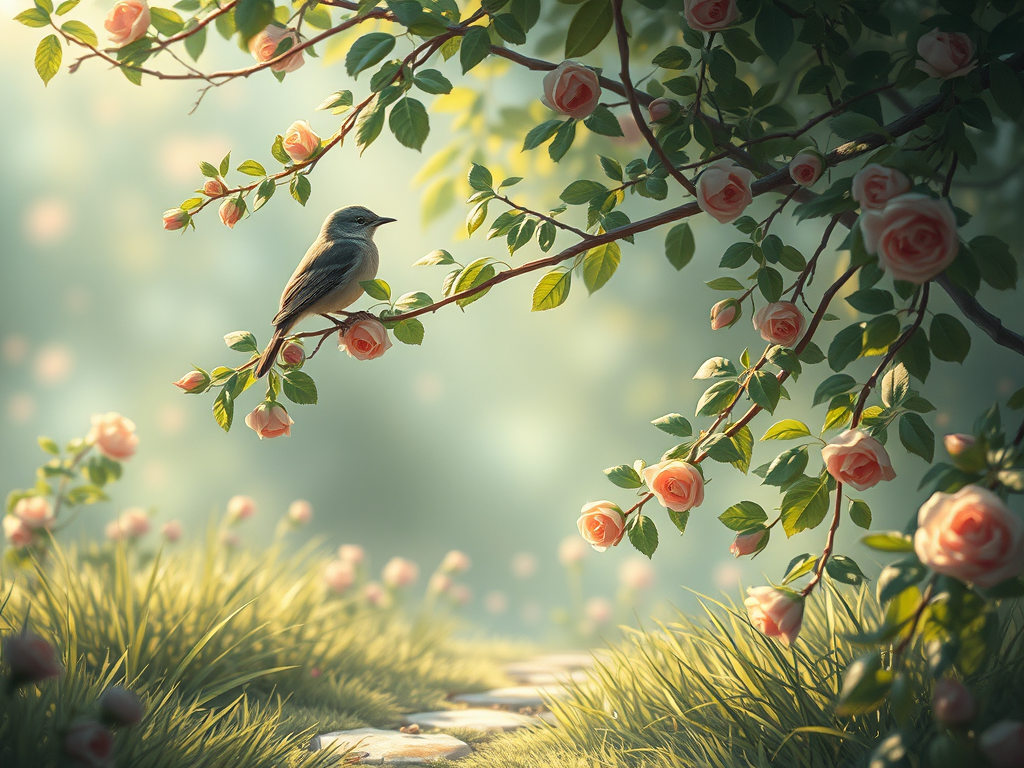
In the oldest part of the city, tucked behind tall buildings where most people never thought to look, there was a small garden.
No fountains. No statues. Just roses that climbed without hurry, grass that grew in quiet patches, and one old wooden bench beneath a tree.
And in that tree lived a nightingale.
She was small. Her feathers were the soft brown of fallen leaves — easy to miss if you weren’t paying attention. But when she sang, something in the air changed.
Her song wasn’t loud. It didn’t demand anything. It rose gently, like steam from a warm cup, drifting through the garden as if it had nowhere urgent to be.
The other birds didn’t understand her.
One afternoon, a blackbird tilted his head and said, “You will never be heard that way.”
“Heard by whom?” she asked.
“By everyone,” he said. “What is the point of a song the whole world doesn’t notice?”
She thought about that for a long time.
That evening, she tried singing louder. She pushed her voice up toward the rooftops, stretching it as far as it could go.
The sound surprised even her.
It was powerful. It was impressive.
And it was not her.
The garden didn’t lean toward her the way it usually did. The roses didn’t sway. Even the breeze felt uncertain, as if it no longer recognized the song it was carrying.
She stopped mid-note and listened to her own echo fade.
It sounded hollow. Like a laugh in an empty room.
That night, she returned to her branch and let her real song come back. Soft. Warm. Steady. She sang not to be noticed — but because singing was as natural to her as breathing.
The flowers listened.
The moon listened.
And that was enough.
Autumn arrived quietly, as it always does.
In one of the tall buildings facing the garden lived a boy named Eli. He was seven years old, and lately the world felt too loud — school, noise, his own thoughts crowding together like too many people in a small room.
One evening, he slipped outside without quite knowing why. He just needed somewhere quiet.
He found the garden gate open.
He stepped inside.
The city noise softened immediately, as though someone had gently closed a door. The air smelled of damp earth and late roses. Eli sat on the old bench, pressed his hands together, and tried to breathe.
That was when he heard it.
Soft. Close. Unhurried.
The nightingale was just above him, singing the way she always did — not for anyone, just because.
Her song didn’t try to fix anything. It didn’t tell Eli what to feel or how to be better. It simply wrapped around him, note by note, like a blanket placed carefully around tired shoulders.
Each pause seemed to whisper — there is no hurry.
Eli’s shoulders dropped. His breathing slowed. The tightness in his chest loosened into something that felt almost like relief.
A single tear slipped down his cheek — not from sadness, but from the strange comfort of being understood without having to explain anything.
When the song ended, he looked up.
The small brown bird looked back at him.
“Thank you,” he whispered.
She answered with one last quiet note.
Eli came back the next evening.
And the one after that.
Soon, others found the garden too — not crowds, not people looking for excitement, but quiet ones. A nurse after a long shift. An old man with folded hands. A student who read beneath the tree.
They didn’t come for spectacle. They came for stillness.
One morning the blackbird returned and perched beside the nightingale.
“More seem to be listening now,” he said.
“I haven’t changed anything,” she replied.
He was quiet for a moment.
Below them, Eli sat on the bench with a book open and a small smile on his face.
“I never sang to be heard by everyone,” the nightingale said softly. “Only to be true.”
The blackbird said nothing after that.
And in the garden, something continued to grow — not louder, not grander — just steadily, gently, the way the best things always do.
The nightingale sang once more.
Not to impress. Not to compete.
Just to offer.
And somehow — the way soft things sometimes do — her song traveled farther than any of the loud ones ever had.
Not across rooftops.
Straight into the heart.
 WonderWhisper
Leave a comment