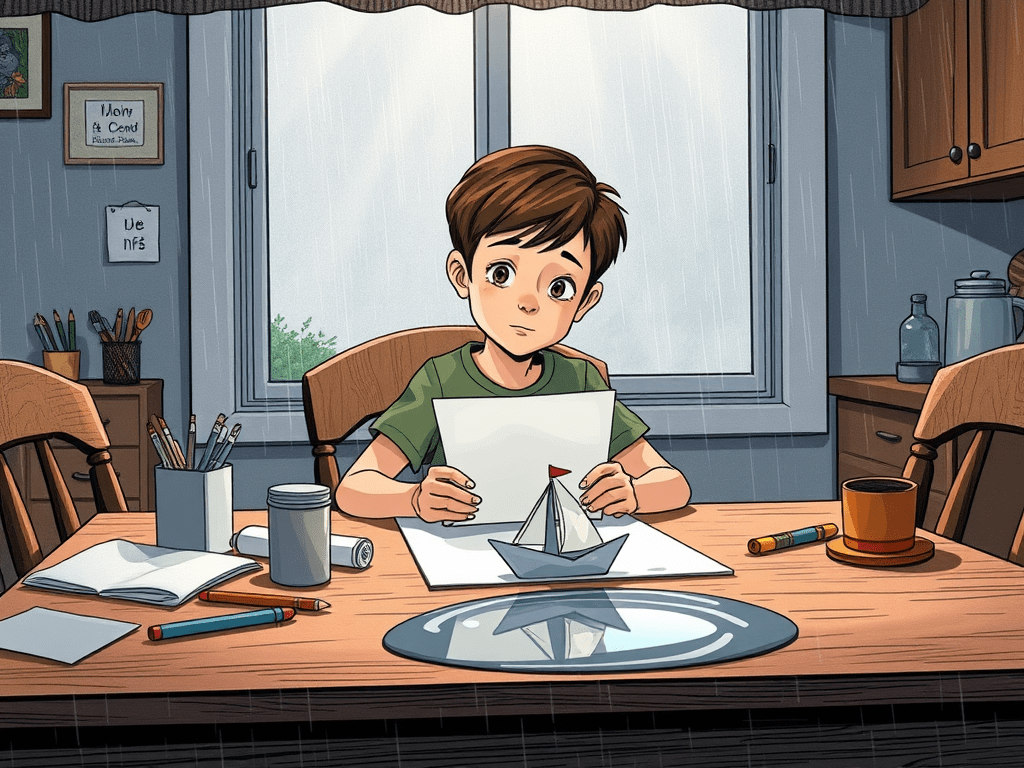
On a gray, rainy afternoon, eight-year-old Milo sat at the kitchen table, staring at a crumpled piece of paper in front of him.
It had once been his best drawing.
That morning at school, Milo had drawn a lighthouse standing bravely against crashing waves. He had spent nearly an hour shading the sky, carefully coloring the sea in three shades of blue. The lighthouse leaned slightly to one side — not because he wanted it to, but because his ruler had slipped.
When he showed it to his classmates, a boy named Aaron laughed.
“Why is it falling over?” he asked.
“It looks like it’s melting!” another added.
The laughter stung. Milo’s cheeks burned. His hands tightened around the paper. He had tried so hard. And maybe it really was crooked.
Now, at home, the rain tapped steadily against the windows, a quiet rhythm that seemed to echo his disappointment. The garden outside was dotted with puddles that reflected the dull gray sky. Milo’s drawing lay wrinkled on the table, its edges bent from being shoved into his backpack.
“It wasn’t that bad,” his mother said gently, but Milo only shook his head.
He picked up a fresh sheet of paper. For a long moment, he just stared at it. The white surface felt too perfect — too ready to show mistakes. Then, slowly, carefully, he began folding.
First in half. Then in half again. Edges pressed down with the side of his thumb. A triangle formed. Another fold. Then a gentle pull outward.
A small boat appeared in his hands.
It wasn’t perfect. One side dipped lower than the other. The bottom didn’t sit completely flat. The top corner bent slightly.
Milo examined it.
“It’s a little crooked,” he whispered.
He didn’t unfold it. Instead, he put on his rain boots and stepped outside. The garden smelled fresh and earthy. Raindrops still fell softly, landing in puddles and making ripples that spread like tiny rings on the water.
Near the garden gate, a large puddle had formed along the stone path. Milo knelt beside it.
He placed the paper boat on the water.
It wobbled immediately.
The paper darkened where it touched the puddle. A drop of rain landed on its folded roof. The boat tipped slightly to one side, almost dipping beneath the surface.
From over the fence, Mrs. Carter peeked out.
“Oh dear,” she chuckled. “That won’t last long in this weather.”
Milo felt the familiar tightness in his chest — the same he had felt at school. The boat rocked again, bumping gently against a floating leaf.
For a moment, Milo wanted to rescue it.
But he stopped himself.
“It has to try,” he whispered.
The little boat drifted slowly across the puddle. It leaned when the wind nudged it. It swayed when a raindrop struck. Each time it seemed ready to collapse, it adjusted — turning slightly, shifting its balance, finding a new position.
It did not fight the water. It moved with it.
Milo followed beside it, careful not to splash. His eyes never left the small, fragile shape.
The boat approached a narrow stream where water spilled from the garden bed onto the path. The current was stronger here, and twigs and tiny stones created obstacles.
“This is it,” Milo thought.
The boat dipped dangerously as it entered the stream. One side sagged. The folded roof bent under the weight of water. Milo held his breath.
The boat spun sideways… then straightened. It slipped between two leaves and continued forward, slower now, but still afloat.
By late afternoon, the rain stopped completely. Sunlight broke through the clouds, casting golden light across the wet garden. The puddle had grown calm.
Milo reached down and lifted the boat in both hands. The paper was soft now, almost silky from the rain. The once-sharp edges had rounded. The folds were no longer stiff.
But it was still a boat.
It had survived the rain, the current, and the doubt.
Milo thought about the lighthouse he had drawn that morning. Yes, it had leaned. Yes, the lines weren’t perfectly straight. But it had still stood against the waves in his imagination. And just like the boat, it had endured the storm of doubt that tried to knock it down.
For the first time that day, Milo smiled truly. He no longer felt the weight of laughter or the sting of judgment. He understood now that it wasn’t about being perfect. It wasn’t about being the fastest, the strongest, or the most admired. It was about trying, about continuing, about holding on gently when the world pressed against you.
Milo placed the paper boat carefully on the windowsill, where the sunlight warmed its damp edges. He picked up a pencil and began a new drawing. The lighthouse leaned slightly to the left, the waves curved unevenly, and the colors went outside the lines.
And Milo didn’t mind.
Because he had learned something important: even the smallest, most fragile creations can travel far if they just keep trying.
Even when no one is watching, even when the path is crooked, even when the rain falls hard.
Some journeys are quiet. Some victories are gentle.
And sometimes, the bravest thing you can do is keep floating.
The paper boat had shown him that.
And Milo would never forget.
 WonderWhisper
Leave a comment